



Is that a pelican? Why is there a pelican on the front of the altar?
When my family and I moved parishes last Fall, these were some of the first questions I asked my wife. Even though I have been Catholic my entire life, I had never seen an image of a pelican in any of the churches I had attended to this point. Little did I know that the mother pelican feeding her nestlings was the most ancient Christian symbol for Jesus Christ, and even pre-dates the image of the cross.
With today being the great feast of the Sacred Heart of Jesus, I found it fitting to finally write about this image. The symbol of the mother pelican harks back to the ancient world, before the pre-Christian era. In times of famine, the mother pelican would strike her breast with her beak to feed her young nestlings. Although she would die, her young chicks would live. With these images, it’s easy to see why so many in the early church used this image to reflect Jesus on the cross.
The mother pelican is the symbol of Jesus Christ, who gave up his life for the redemption of our sins. Because of the Fall of Man in Genesis, we were dead and corrupted by sin, but we have new life through his blood on the cross. 2000 years later, we are still being fed through the Holy Eucharist – Body, Blood, Soul, and Divinity.
This concept of Christ as the mother pelican feeding her nestlings can be found in the early Christian work, Physiologus. Written in Alexandria, Egypt, during the second century, it explains how legendary animals such as the Phoenix and the unicorn were given allegorical interpretations to reflect the life of Christ. This text was referenced by the early church fathers – St. Epiphanius, St. Basil, and St. Peter of Alexandria. It also found popularity again in the Middle Ages. The mother pelican was often depicted in stone work and good carvings.
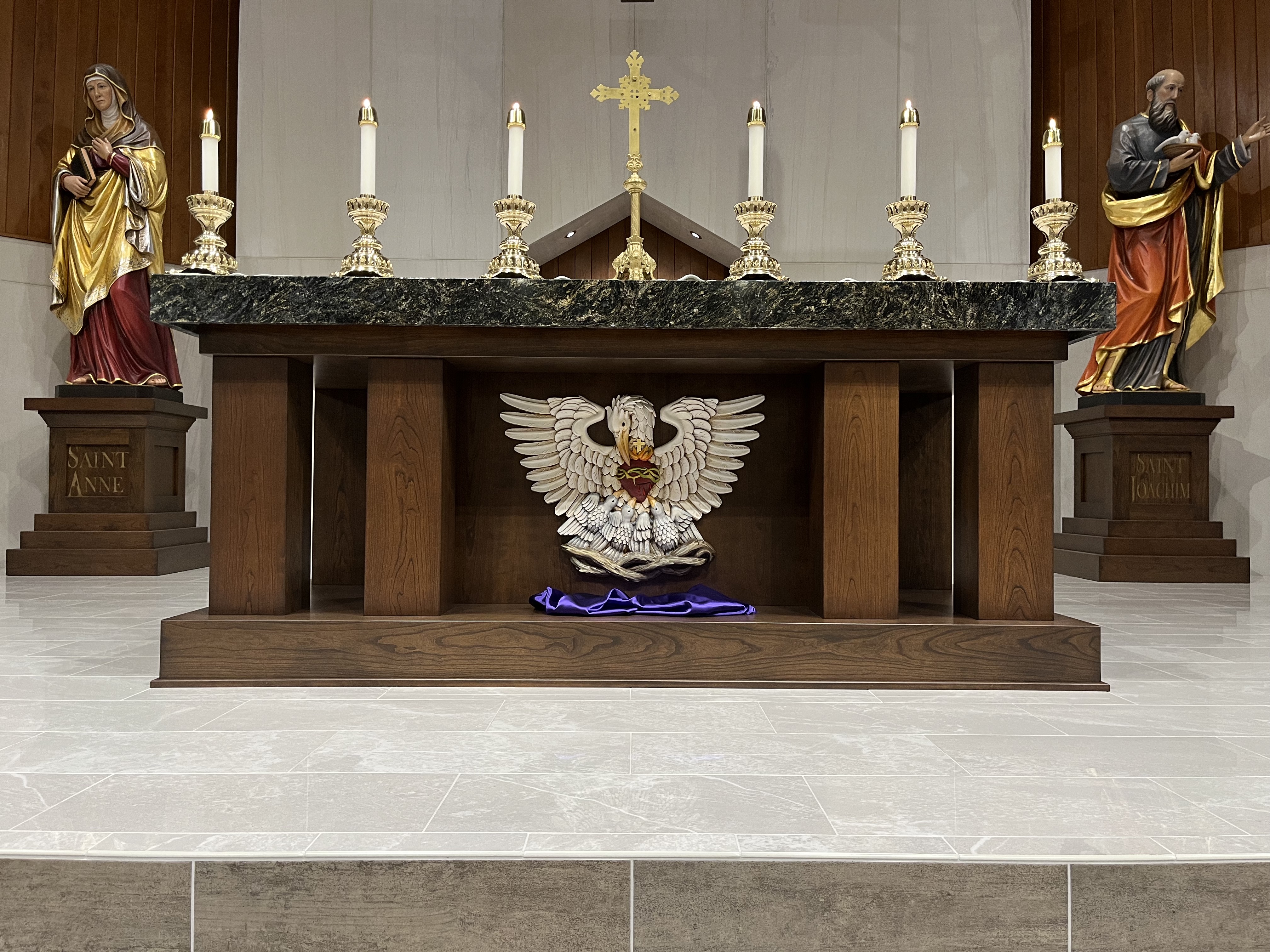
As it is with our parish, the pelican has been an element within the liturgy of the Catholic Church, especially on the front of high altars. During the persecution of the Catholic Church in England during the reign of Henry VIII, monasteries began creating tabernacles in the shape of a pelican and suspending them in the air above the sanctuary to keep the Eucharist safe from desecration.
We also see mention of Jesus Christ as the pelican in the Latin hymn, “Adoro te devote, written by the Angelic Doctor, and translated here in English, which states –
Like what tender tales tell of the Pelican
Bathe me, Jesus Lord, in what Thy Bosom ran
Blood that but one drop of has the power to win
All the world forgiveness of its world of sin.
As we celebrate and reflect on Jesus’ most Sacred Heart, an image so many have in their homes, juxtaposed with the image of the Immaculate Heart of Mary, we should remember and embrace that the suffering of Jesus on the cross feeds us with the Holy Eucharist. There is nothing more personal in our relationship with Jesus Christ than eating and consuming him in the Holy Eucharist (See Bread of Life Discourse, John 6).
Fr. Gregg Hochhalter, Pastor of Saint Anne Catholic Church in Bismarck, ND, stated yesterday in his weekly, Anima Mea, “Devotion to the Most Sacred Heart of Jesus does not threaten or hinge upon heaven or hell; it is a magnificent practice in the Church that has led souls from their sad sin to the glories of a joyful life.”
Sacred Heart of Jesus…Have mercy on us
Categories: Catholicism, Sacred Art




 TOM PERNA