“Mondays with Mary” – Saint Francis de Sales on the Annunciation

As we enter the Season of Easter and celebrate the Resurrection of Our Lord Jesus Christ, the historical and transcendent event, we will also commemorate the Solemnity of the Annunciation of the Lord on April 8. This solemnity is usually commemorated on March 25 (9 months before Christmas), but since it fell on the Monday of Holy Week, the Church transferred the solemnity to next Monday. The Church’s decision was based on the fact that Holy Week takes precedence over any of the solemnities and feasts in the liturgical calendar.

As I have done over the past year with other Marian solemnities, I will focus on the Annunciation of Our Lord for two weeks. This week will be the words from one of the great Saints and Doctors of the Church – Saint Francis de Sales. I have written about him and quoted St. Francis de Sales quite a few times over the past months. You can read his words on many of the Marian solemnities here. Next week, April 8, I will write on the Annunciation itself and provide you with some important theology regarding the great announcement of Our Lord Jesus Christ, and the role that Mary plays in this epic event.

The following excerpts are from a sermon given by Saint Francis de Sales on March 25, 1621 at a religious Profession –

“This sacred Virgin was, then, a very perfect religious, as we have said, and she is the special Protectress of souls who dedicate themselves which she practiced and manifested more excellently than all others on the day of her glorious Annunciation, virtues which I will only mention in passing and then I will conclude. First, a virginity and purity which has nothing like in in all creation. Secondly, a sovereign and profound humility, joined and united inseparably to charity.”

“Virginity and absolute chastity is an angelic virtue; but though it belongs more especially to angels than to men, yet the purity of Our Lady infinitely surpassed that of the angels, having three great perfections above theirs, even that of the cherubim and seraphim…that of the angels is sterile and can produce no fruit. On the contrary, that of our glorious Mistress was not only fruitful because she produced for us this sweet Fruit of Life, Our Lord and Masters, but in the second place she has begotten many virgins. It is it in imitation of her, as we have said, that virgins have vowed their chastity.”

“But she was not only virgin par excellence above all others, angels as well as men – she was also more humble than all others. This was manifest excellently on the day of the Annunciation. She then the made the greatest act of humility that was ever made or ever will be made by a pure creature; for seeing herself exalted by the angel who saluted her, saying she was full of grace and that she would conceive a Son who would be both God and Man…Our Lady, being reassured by the angel and having learned what God willed to do with her and in her, made this supreme act of humility, saying: I am the servant of the Lord. Let it be done to me as you say. She saw herself raised to the highest dignity that ever was or will be, for though it should please God to create anew many worlds, He could never make a pure creature be greater than the Mother of God.”

“Our Lady humbled herself and acknowledged herself unworthy of being raised to the high dignity of Mother of God; therefore she was made to be His Mother, for she had no sooner uttered the protestation of her littleness than, having abandoned herself to Him by an act of incomparable charity, she became the Mother of the Most High, who is the Saviour of our souls.”

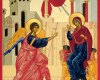
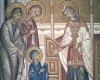
Annunciation icon

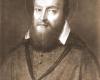
Saint Francis de Sales, Bishop and Doctor of the Church

St. Francis de Sales

Early Life and Adolescence:

  • Born prematurely (August 21, 1567 at the Chateau de Sales in Savoy) and was frail most of his life, but remained very active throughout his life.
  • He was “homeschooled” by his mother until the age of 8 years old.
  • At the age of 8 years old, he was sent to the College of Annecy (received First Holy Communion and one year later Confirmation).
  • At the age of 14, he was sent to study at the University of Paris (one of the great universities of the time with 54 colleges).
  • He chose the College de Clermont (Overseen by the Jesuits and was for men having the vocation to the priesthood).
  • While in this college, he was known to be a great student in the disciplines of rhetoric, philosophy, and theology.

Adult Life:

  • At the age of 24, he took his final degree and was a doctor of law at Padua (Italy).
  • Had a desire in his heart to become a priest. His Mother supported him; his Father did not at first, but eventually consented.
  • On December 18, 1593, he was ordained a priest.
  • First mission as a priest was to win back the people of Chablais on the south shore of Lake Geneva (their faith was outrageously poor).
  • He wrote ‘Controversies’ – a volume of little papers that he sent to the people he ministered to about the faith. They were written under great stress and difficultly because reaching the minds and hearts of the people proved to be challenging.
  • He suffered greatly, was beaten, and attacked by wolves, but remained steadfast in his love for the Lord and his work as a priest.
  • Through his hardships, eventually lapse Catholics (today’s term – Fall Away Catholics) began to return to the Church and received reconciliation.
  • His Bishop visited one time and was impressed with the hearts of the people and saw the great fruit that Francis was cultivating.

Bishop of Geneva and Later Life:

  • Was elevated to the Episcopacy in 1602
  • As Bishop, he developed a catechesis program (after his death the catechesis became known as “Bishop’s Catechisms”).
  • He was very generous and had great devotion.
  • The children of Geneva loved him dearly and followed him around.
  • He dealt with souls with gentleness, care, compassion, charity, and humility. A famous quote of his – “Bring me souls…away with the rest.”
  • He influenced St. Jane Francis de Chantal to open the Order of the Visitation.
  • Introduction to the Devout Life was his greatest book that stemmed from his instruction and advice to a cousin of his by marriage. The text was published in 1608 and became, and still is today, a spiritual work of art.
  • As he progressed in age, his health became more and more frail, even though many people wanted to meet him and speak with him on a daily basis.
  • He died on the feast of the Holy Innocents as people gathered around his deathbed praying the litany for dying. He died at the age of 56 years old.

After Death:

  • Entered Eternal Glory on 1623 (Last word from this lips – “Jesus”)
  • Was Beatified in 1662 (St. Peter’s in Rome; first solemn beatification to happen there)
  • Canonized as a universal saint of the Church in 1665
  • He was declared a Doctor of the Church in 1877 by Pope Pius XI and name Patron of Journalists

To read his some of his words, please read the following Mondays with Mary posts on the Assumption of Mary, the Immaculate Conception of Mary, and the Presentation of Mary in the Temple.

“Mondays with Mary” – St. Francis de Sales on the Immaculate Conception

As we enter the month of December, we enter the Season of Advent – four weeks of hopeful preparation anticipating the coming of Jesus Christ on Christmas Day. As important as the Season of Advent and Christmas are in the life of the Church, we also celebrate the great Solemnity of the Immaculate Conception on December 8. This is the feast where the Church commemorates the Conception of Mary immaculately in the womb of her mother. On Friday, I will post a special edition of “Mondays with Mary” explaining the fourth doctrine which is so important in the life of the Church.

As for today’s post, I want to share with you some words of wisdom from one of the great Doctors of the Catholic Church – St. Francis de Sales St. Francis de Sales. Over the past months, it has been my great pleasure to share with you the words of this holy and learned saint. On August 6, I wrote the post, St. Francis de Sales on the Assumption of Mary and on November 19, there was The Presentation of the Blessed Virgin Mary. Today’s post is St. Francis de Sales on the Immaculate Conception of Mary. It is important to note that at this time in Church history, the Immaculate Conception had not been formally declared dogmatic as of yet – that came in the year 1854 by Blessed Pope Pius IX. It was also not a holy day of obligation in France yet, where St. Francis de Sales lived and preached.

The excerpt below is from a sermon given on December 8, 1622 -

“As for Our Lady, the most holy Virgin, she was conceived in the usual way of generation. But since in His plan God had predestined her from all eternity to be His Mother, He kept her pure and free from all stain, although by her nature she could have sinned. There is no doubt about that, as far as actual sin is concerned.

Let me make a comparison in order that you may understand better. Do you know how pearls are made? (Many ladies desire pearls but they do not care about their origin.) Mother-of-pearl fish do as the bees do. They have a king and choose for that role the largest among them, the rest following him. They come on ocean waves when the air is freshest, which is at break of day, principally in the month of May. When they are all there they open their shells toward Heaven, allowing drops of dew to fall into them. They then clamp shut upon these drops in such a manner that they incubate this dew drop and convert it into a pearl, which is then considered so valuable. But notice, they close their shells in such a way that no salt water enters.

This comparison will serve my purpose well. The Lord has done the same for the Blessed Virgin, Our Lady, because at the instant of her Conception He placed Himself between her and sin – or rather, one might say, under her, to prevent her from falling into Original Sin. In the above example, if the drop of dew does not find the shell to receive it, it will fall into the ocean and be converted into briny and salty water. But if the shell receives it, it is changed into a pearl. In the same way the most holy Virgin was cast into the sea of this world by the common way of generation, but preserved from the salty water of the corruption of sin. It was fitting that she have this particular privilege because it was not reasonable that the devil be able to reproach Our Lord with the claim that she who had carried Him in her womb had [in Original Sin] been subject to him. It is for this reason that the Evangelist does not make mention of the father and mother of the Virgin, but only of Joseph, the husband of a Virgin named Mary. It was of her that Jesus who is called the Messiah was born. [Matt 1:16]. Thus by a special grace her soul possessed nothing [of Original Sin] from her earthly parents, as is the case will all other creatures.”

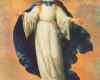
immaculate conception #2

You can see why St. Francis de Sales is a saint and Doctor of the Church. In three small paragraphs, he explains with the eloquence of angels the beauty of the Immaculate Conception. We are truly blessed to have such words at our disposal in the Church today. These words help us understand the mysteries of God’s kingdom more and more each day. They also display the importance of the Blessed Mother immaculately conceived through the power of God.

“Mondays with Mary” – The Presentation of the Blessed Virgin Mary

This coming Wednesday, November 21, is the Memorial of the Presentation of the Blessed Virgin Mary (in the Temple) and that is why today’s “Mondays with Mary” is dedicated to this important date in the liturgical calendar.

As stated by tradition, the Blessed Virgin Mary, as a child around the age of three, was brought to the Temple and presented before the Lord. This celebration has its origin in an Eastern Rite of the Catholic Church (more than likely Syria). It seems from Church writings that the feast begin somewhere between the 7th-11th centuries in the East. It has its celebration origins in the Latin Church sometime during the 14th century and around the time of the Avignon Papacy. In Greek circles, the feast is known as the Entrance of the Blessed Virgin Mary into the Temple. It is believed that the Blessed Virgin Mary also during this day entered the Holy of Holies, being the first woman to ever do so. Some will disagree with that last statement; however, this memorial is to show the Blessed Virgin Mary’s dedication to the service of God and complete and total obedience to his will. Even as a small child, the Blessed Mother knew how important it was to be aligned with the will of God.

I draw upon St. Francis de Sales, one of thirty-five Doctors of the Church to assist in our understanding and reflection of this important day in the life of the Blessed Mother and the Church she would eventually protect. The excerpts below are from a sermon given by St. Francis on November 21, 1617 –

“Similarly, never was “so much perfume” and ointment offered to God in His Temple as the most holy Virgin brought with her on this day. Never until then had the Divine Majesty received so excellent and pleasing a gift as the offering He received from the blessed St. Joachim and St. Anne. They went to Jerusalem to fulfill the vow they had made to God to dedicate their glorious child to Him in the Temple, where young maidens were brought up for the service of the Divine Majesty.”

Do you not see that our glorious Lady was longing to see the day when her parents would offer to God, for it is true that she had the use of reason from the time of her Conception?…Moreover, the holy Virgin and her glorious Son, Our Lord, had the use of reason from their mother’s wombs and were, consequently, endowed with much knowledge. Nevertheless, they concealed it under the law of profound silence.”

“Oh, my God, how I wish I could adequately picture to myself the sweetness and consolation of this trip from St. Joachim’s home to the Temple of Jerusalem! What contentment this little child displayed in seeing that the long-awaited hour had finally come! Those who went to the Temple to adore and offer gifts to the Divine Majesty sang all along the way. The royal prophet David composed a psalm expressly for this purpose, and Holy Church has us say it every day in the Divine Office: “Beati immaculati in via” [Ps. 119] – “Happy are they whose way is blameless,” who walk in Your way, Lord, without stain of sin. “In Your Way” – that is to say, in the observance of Your commandments.”

St. Francis de Sales continues his sermon by explaining how we, like the Blessed Virgin Mary, must make vows and be obedient to them as we walk this earth. Religious Orders take a variety of vows during their discernment period until they profess final vows. They will also renew these vows on a yearly basis.  St. Francis de Sales says speaking of his own vows, “This commemoration of our vows is made principally to strengthen our fervor, to renew our promises, and to reaffirm our good resolutions.”

For us as Christians, dedication to God begins at the Sacrament of Baptism and continues throughout our Sacramental life. Baptism is the day that we are first dedicated to God. St. Francis says that our birthday is not as important as our Baptismal day, because at our birth we are children of Adam and without grace, but on the day of our Baptism we are filled with God’s grace. Bishop James S. Wall, Diocese of Gallup (NM) once said in a homily, parents and children should celebrate the Baptismal Day by lightening the candle that was given to them on that day just as they celebrate their birthday with candles. He continued by saying the day of our Baptism is the day we are welcomed into God’s family – the Church.

We must be humble, obedient, and always open to God’s will in our lives, just as the Blessed Virgin Mary was from the day of her presentation in the Temple. Let us pray that through her loving and motherly embrace, we may come to know Jesus Christ through the Sacramental life as deeply as she knew Him when she carried Him in her immaculate body.

The Nativity of the Blessed Virgin Mary

Today, we celebrate the feast of The Nativity of the Blessed Virgin Mary nine months after we celebrate the Solemnity of the Immaculate Conception. Today, we celebrate the birth of the Mother of God, who in time would carry in her womb for nine months – Jesus Christ, the Savior of the World. The Blessed Mother has a special place in salvation history for she is the Theotokos – The God-Bearer (declared Dogmatic at the Council of Ephesus in 431 A.D.). She was given the highest mission that any human creature would receive by the Lord himself. On this great day, we commemorate the Blessed Mother’s birth to her parents, Sts. Joachim and Anne.

As I did with the Assumption of the Blessed Virgin Mary into Heaven, I turn to one of the great saints of the Catholic Church, St. Francis de Sales, who gives us a fantastic homily on this important feast in the Church. The excerpts below are from his homily on September 10, 1620 -

“In the beginning of her life she was subject to her mother. She remained with her family to show girls and children the honor and subjection they owe their parents and in what spirit they should live in their own homes. She was presented in the Temple in her youth, when only three years old, to teach fathers and mothers the care they should take in rearing their children and with what affection they ought to instruct them in the fear of God and lead them to His service. In this she was also an example for young girls who consecrate themselves to the Divine Majesty. The she was married, to be a mirror for the married, and finally a widow. Thus Divine Providence let her pass through all the states of life in order that all creatures might find in her, as in a sea of grace, what they need in order to form and adapt themselves to their state in life…

…It is true nevertheless, as I have said, that she was the mirror of the religious life particularly; for from her birth she practiced most excellently that perfect renunciation of the world, the flesh and herself, in which Christian perfection consists. As to the world, at her birth the sacred Virgin made the most perfect and entire renunciation that could be made…

…O God, it is admirable how absolutely and perfectly the sacred Virgin, Our Lady and Mistress, made his renunciation at her nativity! Come close to her cradle, think of the virtues of this holy infant and you will find that she practiced them all to an eminent degree. Question the angels, the cherubim and seraphim, ask them if they are equal in perfection to this little girl, and they will tell you that she infinitely surpasses them…

There she was, that sacred and blessed Virgin, practicing all the virtues, but in an admirable manner that of renunciation of the world. For amid these practices and this exaltation she how she abases herself, not wishing to appear other than as a simple and ordinary infant, even though she had the use of reason from the very moment of her Conception…

…The most holy Virgin made this last renunciation in her nativity in such a way that she never used her liberty. Consider well the whole course of her life and you will see nothing but continual subjection.”

When I read words like this from St. Francis de Sales, I come to love the Blessed Mother more and more each time. Recollecting on my own sins, which she never had to do, helps me try to renounce the temptations of my passions and desires. When faced with such great sin, I must remember to go to Our Lady and ask her to pray for me so that I will overcome all that is put before me in my fallen human condition. I pray that we all can look towards Jesus Christ and his Blessed Mother in times of sin. They will never turn their backs on us. She is our Queen Mother who always brings Jesus to us and takes our requests to the King himself.

“Mondays with Mary” – St. Francis de Sales on the Assumption of Mary

We have now entered the month of August! As Catholics, we should be very excited about the days ahead in the liturgical calendar. For us in the Latin Rite, August 15 is the day we celebrate Mary’s Assumption into heaven. In the Eastern Rite of the Church, the Dormition of Mary is celebrated on August 14. Furthermore, on August 22, we will celebrate the Queenship of Mary. It is my plan to write on all of these important Marian feast days in August through this weekly series – Monday’s with Mary.

For today’s post, I have chosen some excerpts from a sermon given by St. Francis de Sales. The link to the left will provide you with information on this great and holy bishop who influenced the Church so greatly with his vast knowledge of theology that the Catholic Church elevated to him be a Doctor of the Church. He was a major figure in the Catholic Counter-Reformation that occurred in the 17th century and made an impact on the mystical life of the Church that had a renewal in the same century. He was also a teacher. As a high school teacher in the past, and now  a college professor, I have a devotion to him and look to him for guidance and inspiration. When I was teaching high school, I had a quote of his on my bulletin board  – “Bring me souls, away with the rest.” St. John Bosco named his order of priests after him – they are known as the Salesians. There is a Teacher’s Prayer to him as well.

This sermon from St. Francis de Sales was given on August 15, 1618. It covers the aspects of how the Blessed Mother completed the roles of Martha and Mary, her assumption into Heaven, how Our Lord destroyed the devil, the issues Martha had with her sister, how to practice virtue, and the great gift that Our Lord gave to his Blessed Mother as she entered Heavenly Glory. Since this sermon is long, the following are passages I selected for your reading pleasure and knowledge of the Assumption of Mary. As you shall find out, St. Francis de Sales is a mortalist. I will explain that term next week, but many of you should figure it out this week.

“But before speaking of her reception into Heaven, I must tell you how and by what manner of death she died (Treatise on the Love of God). You all know the history of her glorious death. Yet I always feel urged to dwell upon the mysteries we celebrate. Our Lady and most worthy Mistress died at 63, or rather fell asleep in the sleep of death. Some will wonder at this and say: How is it that Our Lord, who loved His Holy Mother so tenderly and so deeply, did not grant her the privilege of not dying? Since death is the penalty for sin and she had never committed any, why did He permit her to die?”

“O mortal, how different are your thoughts from those of the saints, how distant are you judgments from those of the Divine Majesty [Cf. Is. 55:8-9]: Do you not know that death is no longer ignominious but precious [Ps. 116:15], since Our Lord and Master allowed Himself to be attacked by it on the tree of the Cross. It would have not been an advantage nor a privilege for the Holy Virgin not to die, for she had desired death since she saw it in the arms and in the very heart of her most sacred Son. Death is so sweet and so desirable that the angels would consider themselves happy if they could die. And the saints have rejoiced to suffer death, which gave them much consolation, because our Divine Saviour who is our Life [Col. 3:4] had abandoned Himself as a prey to death.”

“When the hour came for the most glorious Virgin to leave this life, love made the separation of her soul from her body, death being only this separation. Her most holy soul went immediately to Heaven. For what, I ask, could have prevented it, since she was all pure and had never contracted the least stain of sin? What prevents the rest of us from going directly to Heaven when we die, as Our Lady did, is that almost all of us have dust or stains on our feet which must be washed away and purified in that place called Purgatory before we enter Heaven.”

“When the most holy soul of Our Lady left her most pure body, this body was carried to the sepulcher and returned to the earth like that of her Son. For it was most proper that the Mother should not have a greater privilege than the Son. But just as Our Lord rose at the end of three day, so did she rise at the end of three days, yet in a different manner, inasmuch as the Saviour rose by His own power and authority and Our Lady rose by the almighty power of God her Son, who commanded the blessed soul of His most holy Mother to be reunited to her body. Certainly it was very fitting that this most pure body should in no way be tainted by any corruption, since that of Our Lord had been drawn from her chaste womb and had reposed in it for nine months.”

“…And just as there was never such an abundance of perfumes seen in the city of Jerusalem as the Queen of Sheba carried with her when she went to visit the great King Solomon, who in exchange made her presents according to his greatness and royal magnificence [1 Kings 10:1-2, 10]; likewise, I say, never were there seen so many merits and so much love carried to Heaven by any pure creature s the most holy Virgin brought there at her glorious Assumption. In reward for this the eternal and great king, the Almighty God, gave her a degree of glory worthy of her greatness, and also power to distribute to her clients graces worthy of her liberality and magnificence. Amen.”

After reading such penetrating words from St. Francis de Sales, it is clear that his theological knowledge of Jesus Christ and Our Lady is great in magnitude. It is also clear why the Catholic Church elevated him to a Doctor of the Church. The fourth excerpt took my breath away, but especially these words – “since that of Our Lord had been drawn from her chaste womb and had reposed in it for nine months.”

Our Lady and Most Chaste Mother Assumed into Heaven…Pray for Us!