



Over 2,000 years of catholic tradition, there have been a few saints given the title of “great” for their contributions to the church. They are Basil, Leo, Albert, Anthony, Gertrude, and today’s doctor of the church, Gregory I. Not only is he great, he is the “Greatest of the Great.”
Gregory was born in Rome around 540 A.D. to Gordianaus, a wealthy Roman senator, and Silvia, whose name appears in the Roman Martyrology. Little is known about Gregory’s father and mother. Gregory’s father is thought to have owned several large properties or estates in and around Sicily.
Gregory received the best education possible in Rome and was set on becoming a public servant. When he turned thirty, Emperor Justin the Younger appointed him as Chief Magistrate for Rome. Although he served the city of Rome with faithful eloquence and was considered one of the wealthiest men in Rome, Gregory gave up his great fortune to devote his entire being and time to God. His home on Clivus Scauri was transformed into a monastery. He dedicated it to St. Andrew. A monk by the name of Valentius was placed in charge.
He had too many talents and gifts to share with the world, so it wasn’t long after he entered monastic life that he became one of the seven deacons of Rome and a papal ambassador to the Byzantine court. Unfortunately, Gregory did not know Greek. Pope Pelagius II called him back around 586 A.D. After being brought back to Rome, he remained in the monastery of St. Andrew with a few other brothers in Rome. He and his brother monks did go and preach the Gospel in Britain for some time, but the people of Rome asked for them to return.
Gregory was just about to become Pope, and Rome was in a terrible situation. The once great city had been sacked four times in 150 years, conquered four times in twenty years, and was on the verge of being attacked again. It was a complete disaster since no one ever repaired the damages brought on by fire, pillage, and natural disasters.
In 590 A.D., Rome was hit again with more misfortune, the biggest being a plague that took the life of Pope Pelagius and many Romans. The priests and people of Rome unanimously chose Gregory as the new Pope. This was at a time in the Church when Popes were either named by their predecessor or elected in this fashion. The Election of a Pope by the College of Cardinals would be established centuries later.
Although he was hesitant to be named Pope, and some claim that he ran away from the city to avoid being forcefully elected (which he was) to the Papal Throne, he would turn out to be one of the greatest Popes and theological minds that the Catholic Church has ever known. The first decision made as Pope was to order a processional and litany through the streets of Rome. He wanted to offer penance for the plague of Rome. People gathered at seven different churches and proceeded to St. Mary Major.
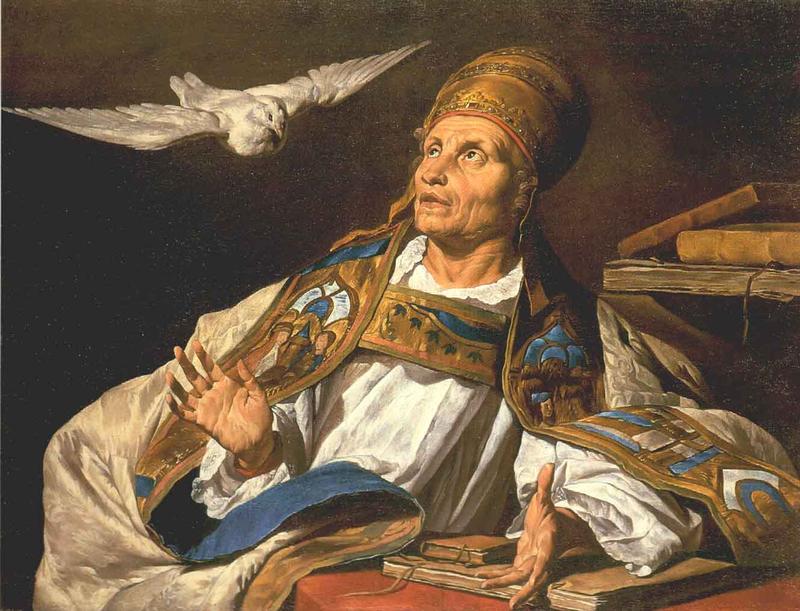
He fought for the poor of the Church and demanded that money would be sent to those in need. He used the money to buy back captives from the Lombard’s (those of the Arian faith), whom he faced from the beginning of his papacy. For years, he endured their assaults, not having a military of his own, but finally, he worked out a treaty that protected Rome and the regions that surrounded the city. He also began to rebuild the city of Rome.
The Catholic Church often gets a poor representation when confronted with the Jews, but if you read history, you will find that many of the Popes of the Church stood alongside our Jewish brothers and sisters. Pope Gregory did not allow the Jews to be oppressed. They were allowed to worship in their synagogues. If they were to convert to Christianity, it would not happen through coercion nor by proselytizing, but through examples of holiness and virtue.
Pope Gregory I is known as the “Apostolic Pastor.” During his papacy, we began to see the models of ecclesiastical government and universal pastoral decisions. His 840 letters prove that he had a concept of apostolic care for the Universal Church. Shortly after his election, he wrote Regula Pastoralis (Pastoral Rule). It was a book on how a Bishop should govern, teach, and sanctify those under his care. It’s considered one of the best books on the clergy ever written. To read an excerpt from the Pastoral Rule and other writing, please see the complementary post, The Words of Saint Pope Gregory I.
He would have a rather hostile relationship with the Byzantine Church and often argued with them through correspondence. He fought for the importance of the hierarchy, especially when John the Faster, Patriarch of Constantinople, declared himself Universal Patriarch. Faced with such pride, Gregory called himself – Servus servorum Dei – Servant of the Servants of God, a title still used by the Popes today.
Saint Pope Gregory the Great also gave the Church other contributions throughout his pontificate. He is considered the “Apostle of England” because he sent missionaries under the care of Augustine of Canterbury to convert the pagan Anglo-Saxons of Britain. He also destroyed paganism in Sardinia and Corsica, disabled Donatism in Africa, and pushed Manichaeism out of Sicily. He loved the missionary spirit of the Church. He worked tirelessly in this endeavor.

Liturgically, Pope Gregory I gave us the tradition of Gregorian Chant, which takes its name from him. Gregorian Chant is used often in Holy Mass and the Liturgy of the Hours. Unfortunately, we don’t have the time to go into this now. I would encourage you to visit the blog, The Chant Café, and the website, New Liturgical Movement, for a deeper understanding of the importance of this traditional and sacred music.
Plague by weakness and a frail disposition his entire life, although it never slowed down his mind from writing and governing the Church pastorally, Pope Gregory I entered eternal glory on March 12, 604. From his General Audience on June 4, 2008, Pope Emeritus Benedict XVI said about Gregory I,
“…Gregory never sought to delineate “his own” doctrine…Rather, he intended to echo the traditional teaching of the Church, he simply wanted to be the mouthpiece of Christ…He was a passionate reader of the Bible, which he approached not simply with a speculative purpose: from Sacred Scripture, he thought, the Christian must draw not theoretical understanding so much as the daily nourishment for his soul… holiness is always possible, even in difficult times.”
Pope Saint Gregory the Great…Pray for Us!
Categories: Saints & Angels




 TOM PERNA
Reblogged this on Sound Art Creator.
Oh!
very wonderful Saint Gregory,
by his example may we live Righteously and never sin.
Very ccreative post